
10 Creative Problem Solving Techniques to Unlock Your Inner Genius
January 30, 2026
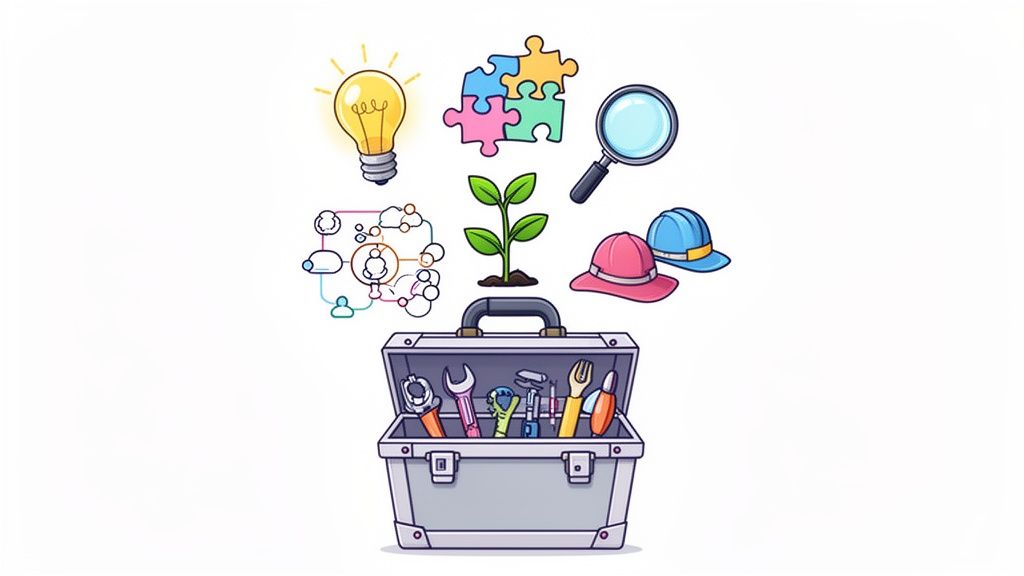
Ever feel like you're staring at a problem, and the only ideas that come to mind are the same old tired ones? We've all been there. Whether you're a teacher trying to make long division fun, a therapist looking for a breakthrough activity for a client, or a parent facing the daily challenge of a bored child, creative roadblocks are real. When your usual approach isn't working, you need a different way to look at the situation.
The good news? Creativity isn't some magical gift reserved for a select few; it's a skill you can learn and a muscle you can strengthen. The key is having the right tools in your toolbox. This guide is your toolkit, packed with powerful and practical creative problem solving techniques designed to break you out of your usual thought patterns.
Forget vague advice. We'll explore each method with simple steps, real-world examples, and even unique ways to use a tool like ColorPageAI to bring your innovative ideas to life visually. Get ready to transform your 'I can't' into 'What if?' and unlock solutions you never thought possible. Let's dive in.
1. Brainstorming
Brainstorming is the classic, go-to technique for generating a high volume of ideas quickly, making it a cornerstone of creative problem solving techniques. Popularized by advertising executive Alex Osborn, its core principle is simple: defer all judgment. By creating a criticism-free zone, you and your team can freely explore every thought, from the practical to the outlandish, without fear of being shut down. The goal isn't to find the perfect idea right away, but to produce a massive list of possibilities that can be refined later.
This approach is perfect when you're at the very beginning of a project and need to open up the field of possibilities. It breaks down mental blocks and encourages building on others' contributions, leading to unexpected and innovative solutions.
How to Apply It
To get the most out of a brainstorming session, follow a few key steps:
- Set a Clear Focus: Start with a specific question or prompt. For example, a teacher might ask, "What are some fun ways to illustrate the water cycle on a coloring page?"
- Quantity Over Quality: Write down every single idea. The more, the better. A silly idea like "a superhero cloud" might spark a more practical one.
- No Criticism Allowed: This is the golden rule. Evaluating ideas during the session stifles creativity. Save analysis for after the storm.
- Combine and Build: Encourage participants to create "hybrid" ideas. A parent and child could combine "dinosaurs" and "space travel" to design a unique "Astro-T-Rex" coloring page.
For a deeper dive into exercises that can supercharge your creative thinking, check out our guide on powerful creative thinking exercises to unlock your innovation potential.
2. Mind Mapping
Mind mapping is a visual thinking technique that helps you explore and organize ideas organically. Popularized by cognitive scientist Tony Buzan, it’s a brilliant way to structure information by starting with a central concept and branching out to related ideas. This approach mimics the way our brains naturally link thoughts, making it an intuitive and powerful tool among creative problem solving techniques. The goal is to see the big picture and the tiny details all at once, revealing connections you might otherwise miss.
This technique is ideal for breaking down complex subjects or planning multi-faceted projects. It transforms a jumble of thoughts into an organized, visual diagram, which is perfect for seeing how different elements relate to one another.

How to Apply It
Creating an effective mind map is straightforward and highly flexible:
- Start at the Center: Place your main problem or topic in the middle of the page. A therapist could start with a central theme like "Building Resilience" for a series of therapeutic coloring pages.
- Create Main Branches: Draw lines radiating from the center for major sub-topics. For "Building Resilience," these might be "Positive Affirmations," "Mindful Moments," and "Strengths."
- Add Sub-Branches: Extend smaller branches from your main ones to add specific details. The "Strengths" branch could have sub-branches for "Kindness," "Courage," and "Creativity."
- Use Keywords and Images: Keep your text brief, using single keywords or short phrases. Add doodles or symbols to make the map more memorable and engaging. A children's illustrator could use this to map out a character's world before designing a coloring book.
A creative activity worth losing track of time in
Type any idea and get a printable coloring page back. Five free pages to start.
3. SCAMPER Method
SCAMPER is an inventive checklist that acts as a catalyst for creative problem solving techniques. Developed by Bob Eberle, it’s an acronym for seven prompts: Substitute, Combine, Adapt, Modify, Put to another use, Eliminate, and Reverse. By systematically asking questions based on these actions, you can dissect an existing idea or problem and reassemble it in countless new ways. The goal is to break free from habitual thinking and uncover fresh, unexpected solutions.
This structured approach is ideal when you have a good starting point but feel stuck or want to elevate it. It provides a clear roadmap for innovation, preventing you from staring at a blank page and instead giving you direct, actionable prompts to spark new concepts.

How to Apply It
To use the SCAMPER method effectively, take your existing idea and run it through the following lenses:
- Substitute: What can you swap out? A therapist could substitute traditional mandala patterns with calming nature scenes to create a coloring page for anxiety relief.
- Combine: How can you merge two ideas? Combine a fairy tale theme with a science lesson, creating a coloring page of "Goldilocks and the Three States of Matter (Solid, Liquid, Gas)".
- Adapt: What can you adapt from another context? Adapt the style of a famous painting like Van Gogh's "Starry Night" into a simplified coloring activity.
- Modify: What can you change or magnify? Modify the scale by creating a tiny, intricate coloring pattern within a single leaf or a giant, simple design for a toddler.
- Put to another use: How can it be used differently? A coloring page of kitchen utensils could be repurposed as a language-learning tool by adding labels in a new language.
- Eliminate: What can you remove or simplify? Eliminate the background details from an animal scene to help a child focus solely on coloring the main subject.
- Reverse: What can you reorder or turn upside down? Create a coloring page showing the "end" of a scavenger hunt first, prompting kids to imagine how they got there.
4. Reverse Thinking (Inversion)
Reverse thinking, also known as inversion, is a powerful creative problem solving technique that flips your perspective on its head. Instead of asking how to achieve a goal, you ask how to cause the opposite outcome. This counterintuitive approach, championed by thinkers like Charlie Munger, helps you identify potential pitfalls, hidden assumptions, and obstacles you might otherwise miss, clearing the path for more robust solutions.
This technique is especially useful when you feel stuck or when a direct approach isn't yielding results. By focusing on what to avoid, you often uncover the essential actions you must take. It forces you to see the problem from a completely different angle, revealing non-obvious strategies.
How to Apply It
To effectively use reverse thinking, you simply invert your problem statement:
- Rephrase the Challenge: Start by flipping your primary question. A therapist might change "How can we make a coloring page therapeutic?" to "What would make a coloring page stressful or counter-therapeutic?"
- Generate 'Negative' Ideas: Brainstorm all the ways to achieve this negative outcome. For the therapist's question, answers could include overly complex designs, triggering imagery, or confusing instructions.
- Translate into Positive Actions: Once you have a list of what not to do, reverse them to create a clear action plan. Avoiding complex designs means you should prioritize simple, calming patterns.
- Identify Critical Success Factors: This process reveals the non-negotiable elements for success. A publisher trying to avoid making a boring coloring book might realize that variety in line weight and subject matter is crucial for engagement.
5. The Six Thinking Hats Method
The Six Thinking Hats method, developed by Edward de Bono, is a powerful creative problem solving technique for looking at a decision from all angles. It organizes thinking into six distinct modes, each represented by a metaphorical "hat." By wearing one hat at a time, you can focus on a single perspective, preventing the common clash between emotion, logic, and creativity that often derails group discussions.
This structured approach forces you to move beyond your typical thinking patterns. It's ideal for evaluating a complex idea thoroughly, reducing conflict in team settings, and ensuring that all facets of a problem, from data to feelings to risks, are considered before moving forward.

How to Apply It
Applying the Six Thinking Hats involves examining your problem through each of the colored lenses, typically in a sequence. The Blue Hat often starts and ends the process.
- White Hat (Facts): Focus only on the data and information you have. A therapist might ask a client, "What are the known facts about this recurring situation?"
- Red Hat (Emotions): Express feelings and intuitions without justification. "This coloring page theme just feels calming and joyful."
- Black Hat (Caution): Play devil's advocate. Identify risks, weaknesses, and potential problems. "Will a highly detailed design be too frustrating for younger children?"
- Yellow Hat (Optimism): Look for the benefits and the value in an idea. "This theme could be a best-seller and teach kids about different cultures!"
- Green Hat (Creativity): Generate new ideas, possibilities, and alternatives. "What if the characters could be customized, or we added a storytelling element?"
- Blue Hat (Process): Manage the thinking process. This hat sets the agenda, summarizes outcomes, and ensures the other hats are used effectively.
6. Lateral Thinking (Random Word Technique)
Lateral thinking, a term coined by Edward de Bono, is a creative problem solving technique that involves approaching issues from unexpected angles. The Random Word Technique is a powerful exercise in lateral thinking where you intentionally introduce an unrelated word into your creative process. The goal is to force new connections between the random word and your problem, breaking free from your usual, linear thought patterns.
This method is perfect when you feel stuck in a creative rut or when conventional solutions aren't working. It deliberately disrupts your thinking to spark completely fresh and innovative ideas that you wouldn't have reached otherwise.
How to Apply It
To use the Random Word Technique effectively, follow these simple steps:
- Pick a Random Word: Use a random word generator or just point to a word in a book. Let's say your challenge is creating a coloring page about "forest animals," and your random word is "symphony."
- Brainstorm Connections: List everything that comes to mind connecting the word to your problem. "Symphony" might evoke ideas of instruments, harmony, rhythm, and a conductor.
- Force Associations: How can a "symphony" relate to "forest animals"? Maybe you design a page of a bear playing a cello made of a log, or a group of birds chirping in a musical pattern. A squirrel could be a conductor leading the "forest symphony."
- Develop the Idea: A teacher could use this to create a unique coloring page activity combining music and nature lessons. A parent might generate a "Vintage Forest Friends" page if the random word was "vintage."
This technique is a fantastic way to build mental agility. For more ways to stretch your creative mind, explore these cognitive flexibility exercises that can boost your problem-solving skills.
7. Design Thinking
Design Thinking is a human-centered approach to problem-solving that puts the end-user's needs front and center. Popularized by firms like IDEO and Stanford's d.school, its core principle is simple: solve problems by understanding people first. Instead of jumping to a solution, this method follows a five-step process: Empathize, Define, Ideate, Prototype, and Test. It's an iterative loop of understanding, creating, and learning.
This approach is perfect for complex, ill-defined problems where the human experience is key. It ensures the final solution is not just functional but also truly desirable and meaningful to the people it’s meant for, making it one of the most effective creative problem solving techniques available.
How to Apply It
To use Design Thinking effectively, move through its distinct phases:
- Empathize with Users: Start by observing and interviewing your audience. A therapist might watch how a child interacts with different art materials to understand their emotional needs before designing a therapeutic coloring activity.
- Define the Core Problem: Synthesize your observations into a clear, actionable problem statement. For example, a teacher might define the problem as: "How can we make learning history dates less intimidating for visual learners?"
- Ideate Potential Solutions: Brainstorm a wide range of ideas without judgment. This is where you might generate concepts from "historical figure coloring pages" to "timeline-based art challenges."
- Prototype and Test: Create a low-cost, simple version of your idea and test it. You could use ColorPageAI to quickly generate a prototype coloring page and see how students react, gathering feedback to refine your approach.
By focusing on real user feedback, this method helps you build more effective and resonant solutions. For more strategies on developing this skill, explore our guide on how to build problem-solving skills.
8. Forced Connections (Morphological Box)
Forced Connections, also known as the Morphological Box, is a powerful technique for systematically discovering new possibilities you might have otherwise missed. Developed by astrophysicist Fritz Zwicky, its core principle is simple: create new relationships by combining unrelated elements. By building a matrix of different attributes or categories and then forcing connections between them, you can systematically explore every potential combination to uncover innovative ideas.
This structured approach is one of the most effective creative problem solving techniques when you need to generate a wide range of variations or break out of conventional thinking. It ensures you explore the entire solution space, making it perfect for developing new products, characters, or educational activities from existing components.
How to Apply It
To use the Forced Connections technique, you build a simple grid or box:
- Identify Key Attributes: First, decide on the core categories or dimensions of your problem. For a coloring page, these might be "Subject," "Environment," and "Art Style."
- List Options for Each: Under each attribute, list as many variables as you can. For "Subject," you might have "dinosaur," "robot," and "unicorn." For "Environment," you could list "space," "jungle," and "city."
- Create a Matrix and Combine: Systematically combine one item from each column. A therapist could use this to create therapeutic tools, combining a "Feeling" (joy), a "Symbol" (sun), and a "Style" (abstract) to design a page about expressing happiness.
- Explore All Connections: Don't dismiss odd pairings. A teacher combining "Ancient Egypt," "science fiction," and "cartoon style" could create a unique and engaging "Pharaohs in Flying Saucers" coloring page that makes history lessons memorable.
9. Analogical Thinking
Analogical thinking is a powerful method for solving problems by finding a "solution blueprint" in a completely different field. Instead of starting from scratch, this technique involves identifying a problem’s core structure and then looking for how other, seemingly unrelated industries or domains have solved a similar structural challenge. It’s about borrowing and adapting brilliant ideas.
This approach is perfect when you feel stuck in a rut or when conventional solutions aren't working. By stepping outside your immediate context, you can uncover innovative frameworks that have already been tested and proven, making it one of the most efficient creative problem solving techniques available.
How to Apply It
To effectively leverage analogies, you need to look for functional similarities, not just surface-level ones:
- Define the Core Problem: Isolate the fundamental challenge. For instance, a teacher might want to keep students engaged over a multi-part lesson. The core problem is "maintaining long-term engagement."
- Find Analogous Fields: Ask, "Who else excels at maintaining long-term engagement?" Video games are a great example.
- Analyze the Analogy's Solution: Video games use progression systems, level-ups, and rewards. These are their solutions to the engagement problem.
- Adapt and Apply: The teacher could adapt this by creating a "leveled" series of coloring pages on a topic like the solar system. Each completed page "unlocks" the next, more challenging planet, creating a sense of progression and achievement.
10. Constraint-Based Creativity
Constraint-based creativity flips the common assumption that freedom is essential for innovation. This technique recognizes that limitations often enhance creativity rather than hinder it. By deliberately working within defined boundaries, like time, resources, or rules, your solutions become more focused and resourceful. Its core principle is simple: constraints force you to think differently. Instead of being paralyzed by endless possibilities, you must find novel ways to solve problems within a given framework.
This approach is perfect when a project feels too broad or overwhelming. It helps narrow the focus, forcing you to prioritize what truly matters and discover clever workarounds you might have otherwise missed. It’s one of the most effective creative problem solving techniques for turning limitations into advantages.
How to Apply It
To harness the power of constraints, integrate them into your creative process:
- Define Your Constraints: Explicitly state your limitations before you begin. For a teacher creating a coloring page, this could be "must only use single black lines, no shading," to ensure it's easy for young children to color.
- Frame Constraints as a Challenge: View your limitations as a creative puzzle, not a roadblock. Ask, "What becomes possible because of this constraint?"
- Focus on the Essentials: Constraints force you to cut the fluff. A therapist might limit a coloring page design to three core emotional symbols to help a client focus on specific feelings.
- Push the Boundaries (Within the Box): See how innovative you can be within the established rules. A parent could use the constraint "must fit on a single A4 page" to design an elaborate, foldable 3D coloring scene instead of a simple flat image.
Creative Problem-Solving: 10-Technique Comparison
| Method | 🔄 Implementation complexity | ⚡ Resource & time | ⭐ Expected outcomes / quality | 📊 Ideal use cases |
|---|---|---|---|---|
| Brainstorming | Low to moderate; simple setup but benefits from skilled facilitation | Low resources; fast sessions (minutes–hours) | High idea volume; variable refinement — requires selection ⭐⭐ | Rapid idea generation for themes (teachers, parents, creators) |
| Mind Mapping | Moderate; needs practice to structure maps effectively | Low–moderate; pen-and-paper or digital tools; 30–120 min | Clear hierarchical organization; improves retention and connections ⭐⭐⭐ | Planning multi-page series, structuring complex concepts |
| SCAMPER Method | Moderate; systematic but easy to learn | Low; works in short sessions per concept | Produces focused, novel variations of existing ideas ⭐⭐⭐ | Improving or remixing existing designs and templates |
| Reverse Thinking (Inversion) | Moderate to high; requires mindset shift and discipline | Low; short workshops or reflection sessions | Reveals hidden assumptions and failure modes; can spark breakthroughs ⭐⭐⭐ | Risk identification, quality improvement, avoiding pitfalls |
| Six Thinking Hats | Moderate; requires team buy-in and time-boxing | Moderate; 30–90 min per session for full cycle | Comprehensive evaluations across perspectives; reduces conflict ⭐⭐⭐ | Team reviews, balanced design decisions, stakeholder alignment |
| Lateral Thinking (Random Word) | Low; simple to run but needs creative follow-up | Very low; quick bursts (5–15 min) | Generates surprising, unconventional ideas; needs refinement ⭐⭐ | Breaking creative blocks; sparking unexpected theme combinations |
| Design Thinking | High; multi-phase, research-heavy workflow | High; user research, prototyping, testing (days–weeks) | Highly relevant, user-centered solutions with validated outcomes ⭐⭐⭐⭐ | Developing market-fit products, therapeutic/educational solutions |
| Forced Connections (Morphological Box) | Moderate to high; requires upfront attribute definition | Moderate; matrix setup and analysis (hours) | Exhaustive combinations; many impractical options but high novelty ⭐⭐⭐ | Systematic product/series planning and exhaustive ideation |
| Analogical Thinking | Moderate; needs cross-domain research and mapping | Moderate; research time for relevant analogies | Fast adaptation of proven solutions; risk if contexts differ ⭐⭐⭐ | Borrowing strategies from other fields to accelerate solutions |
| Constraint-Based Creativity | Low to moderate; depends on constraint design | Low; quick iterations within defined limits | Focused, often elegant solutions; reduces paralysis ⭐⭐⭐ | Working within format/age/printability limits; rapid, practical design |
Your Turn to Create: Go from Problem to Play
You’ve just explored a full toolbox of ten powerful creative problem solving techniques, from the structured logic of Design Thinking to the playful chaos of the Random Word method. We've journeyed through mind mapping our way out of a rut, wearing Six Thinking Hats to see every angle, and even flipping challenges on their head with Reverse Thinking. The common thread woven through all these methods is a simple but transformative idea: problems are not barriers, but invitations to be creative.
The true magic doesn't happen from just reading about these strategies. It comes from doing. It’s about shifting your mindset from seeing a problem as a source of stress to viewing it as a puzzle waiting for a playful solution. Whether you're a teacher designing a lesson plan, a parent navigating a tricky conversation, or an entrepreneur brainstorming the next big thing, these tools are your allies.
Making Creativity a Habit, Not a Hail Mary
The most important takeaway is that creativity isn't a lightning strike of inspiration reserved for a chosen few. It’s a muscle. The more you exercise it, the stronger and more reliable it becomes. Don't wait for a five-alarm fire of a problem to try out SCAMPER or the Forced Connections technique. Start small.
Here are a few actionable next steps to integrate these techniques into your daily life:
- Pick a "Low-Stakes" Problem: What to make for dinner this week? How to organize your digital files? Apply one technique, like a Mind Map or the SCAMPER method, to this simple challenge.
- Schedule "Play" Time: Dedicate just 15 minutes a week to creative exploration. Grab a random object and a random word and use Lateral Thinking to see what new ideas pop up. No pressure, no expectations, just pure creative play.
- Collaborate and Share: Introduce a technique like the Six Thinking Hats in your next team meeting or family discussion. Seeing how others approach a problem with these frameworks can unlock surprising new perspectives for everyone involved.
The goal is to build your confidence and make these creative problem solving techniques second nature. When you practice on the small stuff, you’ll find that when a genuinely complex challenge arises, you won't freeze. You’ll instinctively reach into your mental toolbox, ready to deconstruct, reframe, and innovate. You’ll be equipped not just to find a solution, but to discover a better, more elegant, and imaginative way forward.
Ready to turn these abstract techniques into tangible creations? Put your new skills to the test with ColorPageAI. Use the Random Word or Forced Connections method to generate a wild idea, then instantly bring it to life as a unique coloring page. Head over to ColorPageAI and use your first five free pages to transform a creative spark into a visual masterpiece.
A creative activity worth losing track of time in
Type any idea and get a printable coloring page back. Five free pages to start.