
What Is Constructivist Learning Theory Explained
December 4, 2025

So, what exactly is constructivist learning theory?
Forget the old-school image of students as empty jars waiting to be filled with facts. Constructivism sees learners as something far more dynamic: they're active builders. They take new experiences and information and, using their own prior knowledge as the foundation, construct a unique understanding of the world.
From Empty Jars to Active Builders
The traditional classroom often puts the teacher front and center, broadcasting information to rows of quiet, passive students. It’s a one-way street. Constructivist theory completely flips that model on its head.
It argues that real, lasting learning isn’t about memorizing what you’re told. It’s about actively piecing things together. Students connect new ideas to what they already know, creating a rich, interconnected web of understanding that’s entirely their own. The whole game shifts from rote memorization to active, personal meaning-making.
The Core Shift in Perspective
This isn't just a small adjustment; it's a fundamental change in how we think about education. The goal is no longer to just absorb and spit back information. It's to empower students to think critically, solve messy problems, and build comprehension that sticks.
And it works. When students are in the driver's seat, they don't just learn better—they enjoy it more. A massive meta-analysis found that constructivist teaching had a significant positive effect on both academic achievement and student attitudes. Want to see the numbers for yourself? You can dig into the complete study on constructivist instruction right here.
The central idea is that human learning is constructed, that learners build new knowledge upon the foundation of previous learning. This prior knowledge influences what new or modified knowledge an individual will construct from new learning experiences.
Comparing the Classroom Models
To really grasp the difference, it helps to put the two approaches side-by-side. The contrast in the roles, the activities, and the entire vibe of the classroom is night and day. One champions compliance and repetition; the other celebrates curiosity and collaboration.
This table breaks down the fundamental differences between the traditional and constructivist models.
Traditional Learning vs Constructivist Learning At A Glance
| Aspect | Traditional Classroom | Constructivist Classroom |
|---|---|---|
| Student Role | Passive recipient of information. | Active participant in knowledge construction. |
| Teacher Role | "Sage on the stage" who delivers facts. | "Guide on the side" who facilitates learning. |
| Activities | Lecture, drill-and-practice, memorization. | Projects, experiments, collaborative problem-solving. |
| Learning Focus | Acquiring correct answers and facts. | Developing deep understanding and processes. |
| Assessment | Standardized tests and quizzes. | Portfolios, presentations, and observations. |
Seeing this distinction makes it clear why constructivist learning theory has become so influential. It redefines educational success, shifting the focus from a simple test score to the ability to think, adapt, and create.
Understanding the Pillars of Constructivism
To really get what constructivist learning theory is all about, we need to look at the four foundational pillars that hold it up. These core ideas are the support system for the entire approach, completely changing how we think about knowledge, learning, and the student's role in it all.
Let's break them down.
1. Knowledge Is Actively Constructed
First and foremost, constructivism is built on the idea that knowledge is actively constructed, not just passively absorbed.
Think of it like building with LEGOs. If you hand a box of bricks to ten different people, you’ll get ten completely unique creations. Even with the exact same raw materials, each person’s past experiences, imagination, and goals lead them down a different path.
This is precisely how constructivism sees learning. A teacher provides the "bricks"—the information, resources, and experiences—but it's the learner who actively snaps them together into a structure that makes sense to them. They connect new pieces to old ones, test how they fit, and build something that is uniquely their own. This hands-on process is what turns raw information into real, lasting understanding.
In this model, the learner isn't a vessel to be filled with knowledge, but a builder who creates and assembles their own cognitive structures.
This principle is exactly why active learning is so critical. For more ideas on putting this into practice, you can explore some powerful active learning strategies and examples that get students building instead of just listening.
2. Learning Is a Social Activity
The second pillar tells us that learning is fundamentally a social activity.
Imagine a band getting ready for a show. A guitarist might come up with a great riff, but it only truly comes alive when the drummer adds a beat and the bassist lays down a solid groove. They bounce ideas off each other, adjust their timing, and co-create a song far richer than what any single member could have made alone.
Learning works the same way. Through discussion, collaboration, and even friendly debate, students challenge their own assumptions and start seeing concepts from new angles. They build on each other's ideas, clarify their own thinking by explaining it to others, and solve problems as a team. Since constructivism leans heavily on this kind of collaborative knowledge-building, it’s worth looking at the key concepts of social learning to see how they apply.
This diagram helps show how the learner, knowledge, and teacher all connect in a constructivist setting.

As the visual shows, the learner is at the heart of the process, actively working with knowledge while the teacher acts as a guide or facilitator.
3. Learning Is Contextual
Third, constructivism teaches us that learning is contextual. Simply put, knowledge isn’t an abstract thing floating in space; it’s tied directly to the situation where it’s learned and where it will eventually be used.
Reading a recipe in your living room is one thing. But actually cooking that dish in a real kitchen—with the sizzling pans, the ticking clock, and the messy counters—is a completely different (and much more effective) learning experience.
The context gives the information meaning and relevance. When students learn skills by tackling real-world problems or authentic tasks, the knowledge actually sticks. They get the "why" behind the "what," making it much easier to take what they've learned and apply it in new situations.
4. Prior Knowledge Is the Foundation
Finally, the fourth pillar states that prior knowledge is the foundation for all new learning.
You can't build the second story of a house without a solid first floor. In the same way, new information is almost meaningless until it can be connected to something the learner already understands.
This existing mental framework acts like a set of hooks where new concepts can be attached. If there's nothing for the new information to hook onto, it just floats away. A constructivist teacher gets this. They make a point to activate what students already know before introducing new topics, ensuring every new "brick" has a stable foundation to build upon.
Browse free coloring pages
Hundreds of ready-to-print pages, plus a generator that makes any page you can describe.
Bringing Constructivist Theory Into Your Classroom
Knowing the theory is one thing, but putting it into practice? That’s where the real magic happens. Moving from abstract ideas to a living, breathing classroom means creating a space where students are more like detectives and engineers than just an audience. It’s all about shifting your teaching style to empower them to build their own understanding.
And it's a change that kids really respond to. A survey of 477 students found a huge thumbs-up for these kinds of teaching methods. The study showed that hands-on, student-centered activities were a massive boost for both motivation and engagement. You can dig into the specifics of the study and see just how well constructivist teaching resonates with learners.
So, what does this look like day-to-day? Let's get into some powerful, practical strategies.
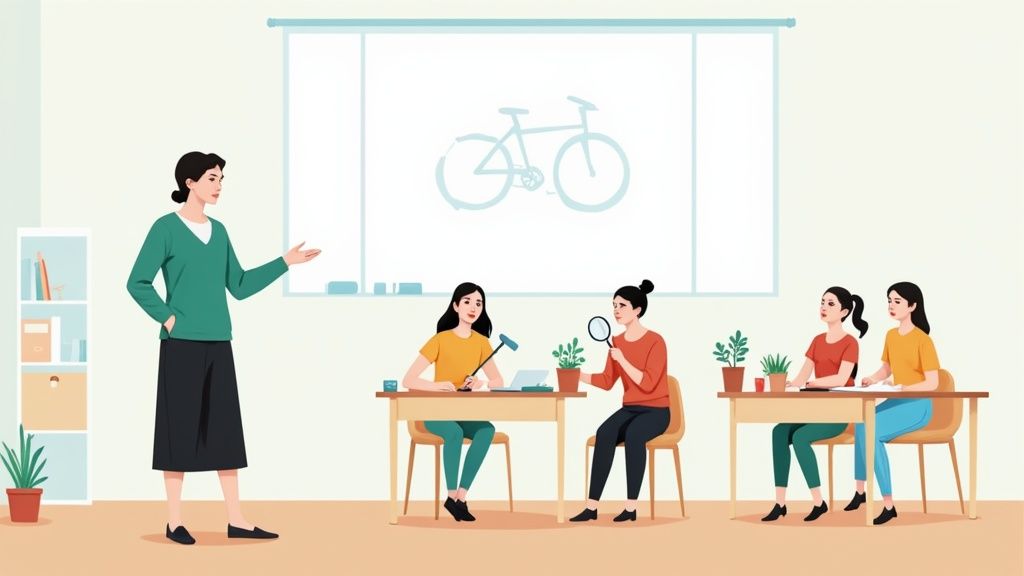
Spark Curiosity with Inquiry-Based Learning
At its core, inquiry-based learning is about turning your students into investigators. Instead of handing them a list of facts to memorize, you give them a juicy question, a tricky puzzle, or a genuine mystery to solve. Their mission is to follow their own curiosity, hunt for clues, and piece together their own answers.
Imagine a history class studying an ancient civilization. The old way might be memorizing dates and rulers. The inquiry-based way starts with a hook: "What really made this powerful empire collapse?"
Suddenly, students aren't just students anymore; they're historical detectives. They might:
- Dig through primary source documents looking for evidence.
- Analyze old maps and artifacts to come up with a theory.
- Debate their ideas with classmates.
Your role here is less lecturer, more guide. You provide the resources and nudge them with good questions, but you let them steer the investigation. This approach turns learning from a passive chore into an active, thrilling pursuit.
Solve Real Problems with Problem-Based Learning
Problem-based learning (PBL) takes this a step further by wrapping the entire lesson around a complex, real-world problem. It’s an incredible way to show students that the stuff they're learning in class actually matters out in the real world.
For instance, a science class could tackle a local environmental challenge, like designing a real plan to cut down on waste in the school cafeteria. This isn't just a worksheet exercise—it's a genuine problem that forces them to use scientific principles, do their own research, and work together on a solution that could actually work.
Students learn the curriculum not because they have to, but because they need it to solve the problem. They aren't just learning about ecosystems in the abstract; they're using that knowledge to try and make a real difference.
Foster Teamwork Through Collaborative Learning
Since constructivism sees learning as a fundamentally social act, collaborative learning is a must. This means designing lessons where students team up in pairs or small groups to crack a problem or complete a project. It’s about more than just "group work"—it actually deepens every student's individual understanding.
A few simple but effective strategies include:
- Think-Pair-Share: Give students a question. They think on their own, then hash it out with a partner before sharing with the whole class. Easy and powerful.
- Group Projects: Teams work together on a bigger task, like building a model, creating a presentation, or running an experiment.
- Jigsaw Activities: Every student in a group becomes the "expert" on one piece of the topic. Then, they teach their piece to the rest of the group.
When students have to explain their thinking to someone else and listen to different points of view, they sharpen their own ideas and build a much stronger, shared understanding.
"Constructivism is not just about doing hands-on activities. It is about students being engaged in constructing their own mental models." - George Hein
Provide Just-in-Time Support with Scaffolding
Finally, there’s scaffolding—the art of giving students the right amount of support at the right time. Think of it like putting training wheels on a bike. You don't just tell a kid to ride; you give them support that builds their skill and confidence, and then you gradually take it away as they get the hang of it.
In the classroom, scaffolding could be anything from:
- Giving students a checklist to guide them through a complex project.
- Providing sentence starters to help them get an essay flowing.
- Modeling how to solve the first part of a tricky math problem.
The key is that the help is temporary. The whole point is to give students the tools they need to eventually tackle the challenge all on their own, armed with new skills and the confidence to use them. It keeps them from getting frustrated while pushing them to grow.
Rethinking How We Measure Student Success
When learning is all about building your own unique understanding, a standardized bubble test just won’t cut it. The constructivist approach demands a complete shift in how we think about success, moving away from simple memorization toward actually assessing the process of thinking and creating.
If students are builders, we need to look at what they've built and how they built it, not just ask them to list the tools they used.
This means embracing authentic assessment, where evaluation is woven right into the learning process itself. Instead of a high-stakes final exam, assessment becomes an ongoing conversation that tracks growth, depth of understanding, and the ability to apply knowledge in meaningful ways.

Moving Beyond the Multiple-Choice Test
Authentic assessment tools look completely different from their traditional counterparts. They’re designed to give students a chance to demonstrate their skills and knowledge in a real-world context, showing what they can do with what they know.
Here are a few powerful examples:
- Student Portfolios: Think of this as a highlight reel of a student's learning journey. A portfolio is a curated collection of work—essays, project photos, lab reports, even self-reflections—that showcases growth over an entire semester. It tells a much richer story than a single grade ever could.
- Performance-Based Tasks: This is where students roll up their sleeves and apply their skills to create something tangible. This could be anything from delivering a persuasive presentation to designing a prototype or directing a short film.
- Observations and Conferencing: The teacher becomes more of a facilitator, observing students as they work and engaging them in one-on-one conversations. These check-ins provide invaluable insight into a student's thought process, challenges, and "aha!" moments.
This shift is crucial, yet many institutions struggle to make the leap. Research shows a significant gap: while over 70% of surveyed universities claimed to use constructivist teaching, only around 40% had aligned their assessment methods to match. You can explore the full study on constructivist implementation to see more on this disconnect.
In a constructivist framework, assessment is not the end of learning but an integral part of it. Its purpose is to guide the next steps in the learning process, for both the student and the teacher.
Comparing Assessment Methods
To really see the difference, it helps to put these two approaches side-by-side. The table below breaks down the goals, methods, and feedback loops of traditional versus constructivist assessments.
| Feature | Traditional Assessment (e.g., Standardized Test) | Constructivist Assessment (e.g., Portfolio) |
|---|---|---|
| Primary Goal | Measure memorization and recall of specific facts. | Evaluate the process of learning, understanding, and application. |
| Student's Role | To reproduce information. | To demonstrate skills and construct meaning. |
| Teacher's Role | To score and grade correctness. | To facilitate, observe, and provide feedback. |
| Feedback Timing & Nature | Often delayed, summative (a final score or grade). | Immediate, ongoing, and formative (aimed at guiding improvement). |
| Context | Abstract, often disconnected from real-world tasks. | Authentic, mirrors real-world challenges and contexts. |
| What's Measured | A single snapshot of performance. | Growth and development over time. |
As you can see, the focus shifts entirely from "What did you remember?" to "What can you do and how did you figure it out?"
The Power of Ongoing Feedback
Perhaps the most important element here is formative assessment. This isn't about grades; it’s an ongoing, informal feedback loop. Think of the quick question a teacher asks a group, the exit ticket students fill out before leaving, or a peer review session where classmates offer constructive criticism.
This continuous feedback helps teachers gauge understanding on the fly and adjust their instruction. For students, it provides low-stakes opportunities to check their own understanding and make corrections without the pressure of a final grade. It’s all about making learning visible and responsive. You can dive deeper into this by reading our guide on how to measure student engagement.
Addressing the Real-World Challenges
Of course, this approach isn't without its hurdles. Authentic assessments can be more time-consuming to create and grade than a simple quiz. Evaluating a complex project also introduces a degree of subjectivity that a machine-graded test avoids.
And with new technology comes new challenges. The rise of AI language models forces us to rethink assessment integrity, raising questions around tools and their ability for detecting AI-generated text with Turnitin.
But these obstacles are manageable. Using clear rubrics can standardize grading and make expectations transparent for students. Integrating peer feedback can lighten the teacher's load while also providing a valuable learning experience for the students giving it.
Ultimately, the rich, detailed picture of student competence that authentic assessment provides is well worth the extra effort. It’s the only way to truly see the unique structures of knowledge each student has built.
Untangling the Common Criticisms and Misconceptions
Let's be real—no educational theory is a silver bullet. And an approach like constructivism, which puts students in the driver's seat, has definitely raised a few eyebrows over the years. People hear "student-led" and immediately picture utter chaos.
But here’s the thing: these critiques aren't roadblocks. They're more like guardrails. They help us implement constructivism thoughtfully, making sure we get all the good stuff without falling into the common pitfalls. So, let’s tackle some of the biggest concerns head-on.
The "Classroom Chaos" Concern
One of the first things people worry about is that a constructivist classroom will just descend into a free-for-all. If every kid is off exploring their own thing, how do you make sure they learn the essentials? The fear is that this freedom creates huge gaps in foundational knowledge.
And you know what? That’s a totally valid concern—if the approach is applied without any structure. But a well-run constructivist classroom isn't about aimless wandering. It's about organized exploration.
The teacher is still the architect of the learning experience. They set clear goals and provide a curated set of resources. Their job is to guide students’ natural curiosity toward specific curriculum targets. The path might be student-led, but the destination is intentional.
"So, Does the Teacher Even Do Anything?"
Another classic misconception is that the teacher basically becomes obsolete. If students are building their own knowledge, does the teacher just sit back and watch? This couldn't be further from the truth.
Constructivism doesn't make the teacher's role smaller; it makes it more dynamic and, frankly, more challenging. The job shifts from being the "sage on the stage" to the "guide on the side."
Think of the teacher as a facilitator, a diagnostician, and a mentor all rolled into one. They have to be masterful at asking the right questions, providing just-in-time support (scaffolding), and figuring out the unique learning journey of every single student.
This is the opposite of a passive role. It demands constant observation, deep engagement, and the agility to adapt to what learners need in the moment.
How Does This Fit with Standardized Testing?
In a world driven by standardized tests, it's easy to see why educators get nervous. How can you possibly prepare students for a multiple-choice exam when they're spending their time on messy, open-ended projects?
This is a real-world hurdle, but it's not a deal-breaker. The best educators find a healthy balance. They blend rich, constructivist projects with focused, direct instruction on core concepts that will show up on tests.
Plus, the very skills that constructivism builds—like critical thinking, problem-solving, and pulling information together from different sources—are exactly what students need to tackle tough questions on any assessment. They're not just memorizing facts for a test; they're learning how to think, which is a skill that serves them long after the exams are over.
Wrapping It All Up: You're the Architect of Your Own Knowledge
If we boil it all down, the core message of constructivism is about empowerment. It's a fundamental shift that pulls the student out of the audience and puts them right at the center of the stage. We’re handing them the blueprints and the tools to build their own unique intellectual home.
We started with a simple idea: a learner is a builder, not a jar waiting to be filled. That analogy is probably the most important thing to take away from all of this.
Real learning isn't about passively collecting random bricks of information tossed out by a teacher. It’s about figuring out how to carefully place each new brick onto a foundation of what you already know, using collaboration and real-world problems as the mortar that locks it all together.
It's a Journey, Not a Test
This whole approach changes the game. Learning is no longer about a destination—acing a test or getting a specific grade—but about a continuous, active journey. The goal stops being about just knowing things and becomes about understanding them so deeply that you can actually use, adapt, and build on them.
Think of it like this: it’s the difference between memorizing a map and actually knowing how to navigate the terrain yourself.
Ultimately, constructivism is built on the idea that the most durable and meaningful knowledge is the kind we build for ourselves. It respects that every learner sees the world differently and trusts them to make sense of it.
From messy, inquiry-based projects to group problem-solving, all the classroom strategies are really designed to do one thing: honor the student as the lead architect of their own understanding. When educators lean into this, they create classrooms where curiosity isn’t just allowed, it’s essential. Engagement goes through the roof, and learning becomes what it was always meant to be—a lifelong adventure.
Frequently Asked Questions
Alright, even after getting the hang of the big ideas, it's totally normal for a few questions to pop up about how constructivism actually plays out in a real classroom. It’s a pretty big shift from the old-school way of doing things, so let's tackle some of the most common ones.
What Is the Teacher's Role in a Constructivist Classroom
The teacher’s role is anything but passive—it’s just different. Instead of being the "sage on the stage" who just lectures from the front of the room, the teacher becomes the "guide on the side."
Think of them as master facilitators. Their job is to:
- Design Environments: Create rich, problem-based learning scenarios that spark curiosity.
- Ask Probing Questions: Push students to think a little deeper and challenge their own assumptions.
- Provide Resources: Offer the tools, materials, and guidance students need for their investigations.
- Scaffold Support: Give just enough help to keep frustration at bay, but not so much that it takes away the satisfying challenge of figuring things out.
Is Constructivism Suitable for All Subjects
You bet. It’s easy to picture how constructivism fits like a glove with hands-on subjects like science experiments or art projects, but its core principles are universal.
Take a math class, for example. Instead of just drilling formulas into students' heads, you might have them work together to solve a real-world budgeting problem. In a literature class, small groups might debate a character's motivations instead of just listening to the teacher explain the theme. The big idea is always about actively building knowledge.
The goal is to move beyond rote memorization in every subject, encouraging students to build a deep, conceptual understanding regardless of the content area.
How Does Constructivism Differ from Behaviorism
These two are like night and day, with totally different views on how learning even happens. Behaviorism basically sees learning as a change in behavior caused by outside forces—rewards and punishments. It's all about stimulus and response. If you do this, you get that.
Constructivism, on the other hand, is all about what’s happening inside the learner's head. It argues that real learning is about building understanding and making sense of the world, not just reacting to it. Behaviorism looks at the "what" (the action), while constructivism is obsessed with the "how" and "why" (the thinking that drives the action).
Ready to bring a little constructivist fun into your classroom or home? With ColorPageAI, you can instantly generate coloring pages for any subject or interest, turning passive listening into active creation. Imagine students designing their own visual aids for a history lesson or coloring complex biological diagrams. Spark their curiosity and let them build their own understanding, one colorful page at a time. Create your first 5 pages for free on colorpage.ai.
Browse free coloring pages
Hundreds of ready-to-print pages, plus a generator that makes any page you can describe.