
what is response to intervention - A Practical Guide
December 5, 2025

Response to Intervention (RTI) is a bit like a safety net for students. It’s a proactive, school-wide framework designed to catch learning challenges early and provide the right help, right when it’s needed, before a small struggle turns into a major roadblock.
A Proactive Safety Net for Student Learning
Imagine a gardener taking care of a big, diverse garden. Most of the plants do just fine with the basics—good soil, water, and plenty of sun. But some plants might look a little weak and could use a boost of fertilizer to thrive. And a few might need some really specialized, intensive care to survive and grow strong.
That's the big idea behind Response to Intervention (RTI). It isn't a rigid curriculum or a specific program you buy off a shelf. Instead, it’s a flexible way of thinking about and organizing support for all students. Rather than waiting for a student to fall seriously behind, RTI identifies kids who are starting to struggle and delivers targeted support that gets more intensive depending on their needs.
The whole approach is built on a few common-sense principles:
- High-Quality Instruction for Everyone: It all starts with the idea that every single student should get excellent, research-backed teaching in their regular classroom.
- Catching Problems Early: The system is set up to spot students who are struggling before their challenges become major learning gaps.
- Using Data to Make Decisions: Teachers frequently check in on student progress with quick assessments. This data helps them make smart choices about whether to adjust their teaching or bring in more support.
- Layers of Support: Help is organized into different levels, or tiers. This makes sure students get the exact amount of help they need—no more, no less.
The Rise of RTI in Education
This framework really became a cornerstone in education after the Individuals with Disabilities Education Act (IDEA) was updated in 2004. By 2012, it was everywhere. A major study found that 90% of elementary schools were using some form of RTI to support reading in the early grades. On average, about 25% of students in these schools were getting targeted Tier 2 help, while a smaller group of 5% received the most intensive Tier 3 interventions. You can dive deeper into these trends in the full research on RTI adoption.
At its heart, RTI flips the script from a "wait to fail" model to a "prevent and intervene" model. It asks a powerful question: "How can we adjust our teaching to meet this student's needs right now?"
This proactive mindset is what makes RTI such a powerful tool for educators and a lifeline for students. It means a child’s academic bumps in the road are met with a quick, structured, and supportive response, opening up more doors for every learner to find success.
Breaking Down the Three Tiers of the RTI Model
The Response to Intervention model is built on a simple yet powerful idea: support should be fluid and layered, much like a sturdy pyramid. Instead of a one-size-fits-all classroom, RTI organizes instruction and interventions into three distinct tiers. This ensures every student gets precisely the level of help they need to succeed.
This structure is all about being proactive. It starts with a strong, universal foundation for everyone and then provides progressively more focused support only for the students who need it.
This pyramid visualizes the model perfectly. The vast majority of students are supported by Tier 1 at the base, with smaller, more targeted groups receiving Tier 2 and Tier 3 interventions.
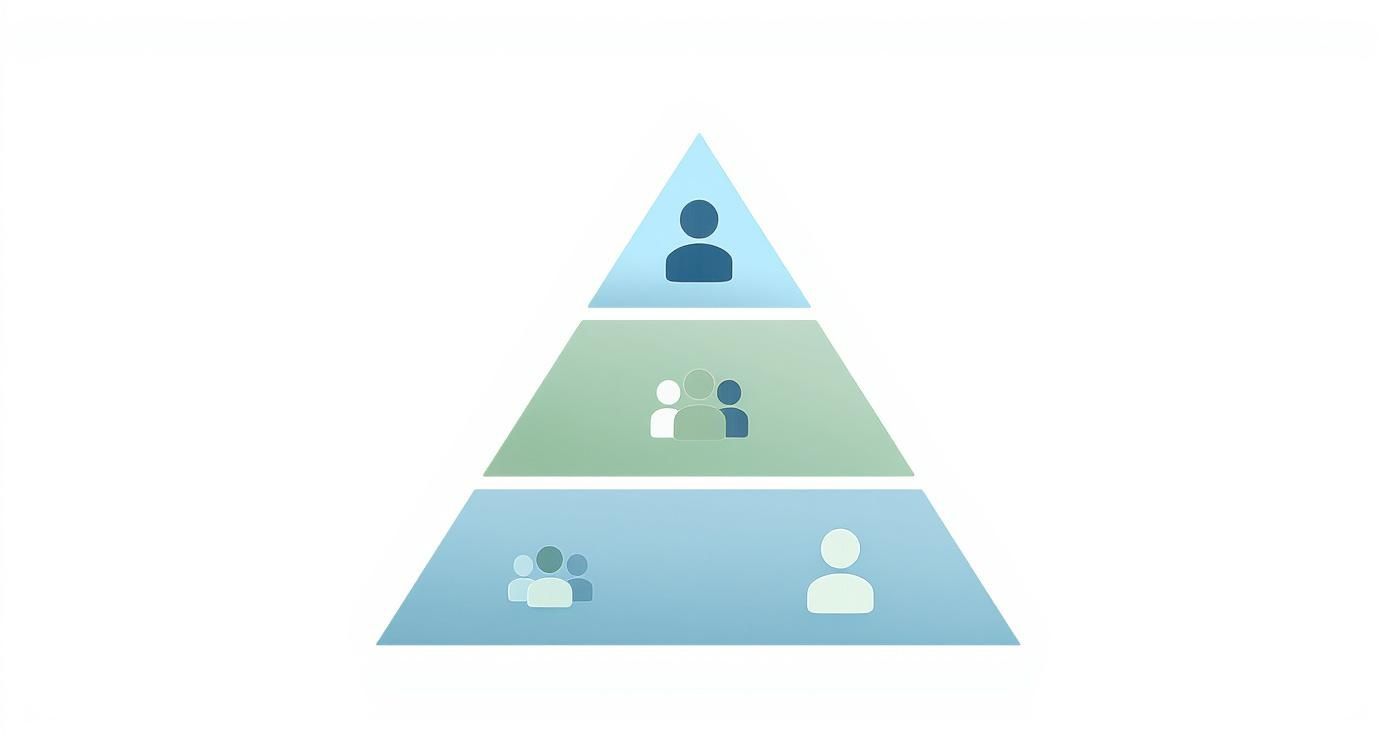
As you can see, the tiers build on one another. The wide base supports the entire student population, while the top represents the most intensive, individualized support reserved for just a few.
Tier 1: The Foundation for All Students
Tier 1 is the bedrock of the whole RTI framework. Think of it as the strong, well-built foundation and core structure of a schoolhouse. This tier represents the high-quality, research-based instruction that every single student in the general education classroom receives.
This isn't really an "intervention"—it's just excellent, universal teaching.
The goal here is to meet the needs of the vast majority of students, typically around 80-90% of the school population. Teachers use proven instructional strategies, an engaging curriculum, and a positive classroom environment to help all learners thrive from the get-go.
In a Tier 1 classroom, a teacher might:
- Use a phonics program that has a strong track record for teaching early reading skills.
- Clearly explain math concepts using visual aids, manipulatives, and hands-on activities.
- Regularly check for understanding with quick tools like exit tickets or whole-class discussions.
The key to Tier 1 is that it's universal. The strategies benefit everyone, creating a rich learning environment that sets the stage for academic success right from day one.
Tier 2: Targeted Support for Some Students
Even with fantastic core instruction, some students will inevitably need an extra boost. That's where Tier 2 comes in. This tier is for the roughly 5-15% of students who need more targeted support to master specific skills they’re struggling with.
If Tier 1 is the main class lecture, Tier 2 is like a small-group study session led by the teacher. These interventions happen in addition to, not in place of, the core instruction everyone else gets. The groups are small, the focus is narrow, and the teaching is much more explicit.
For example, a student having a tough time with reading fluency might join a Tier 2 group that meets three times a week for 20 minutes. During this time, they might practice:
- Repeated Readings: Reading a short passage multiple times to build speed and accuracy.
- Partner Reading: Taking turns reading aloud with a peer and offering feedback.
- Targeted Skill Drills: Focusing specifically on decoding multisyllabic words or recognizing sight words.
Progress for students in Tier 2 is monitored closely, usually every week or two. This data is critical—it tells the school team if the intervention is working or if they need to try a different approach.
Tier 2 is all about precision. It's not about just giving students "more work," but about giving them the right kind of focused practice to close very specific skill gaps.
To keep these sessions engaging, teachers often get creative with materials. Using customized educational worksheets or even themed coloring pages to reinforce a concept, like vowel sounds, can make the extra practice feel less like a chore and more like a fun challenge.
Tier 3: Intensive Intervention for a Few Students
At the very top of the RTI pyramid is Tier 3. This level provides the most intensive, individualized support for the small percentage of students (typically just 1-5%) who haven’t responded adequately to the help provided in Tier 1 and Tier 2.
Think of this as one-on-one tutoring or instruction in a tiny group of two or three. The interventions here are highly specific, more frequent, and last longer than those in Tier 2. The instruction is tailored directly to the student's unique and significant learning challenges.
A student in Tier 3 might receive daily, 45-minute sessions with a reading specialist or special education teacher. The intervention would be highly structured and based on a specific, evidence-based program designed to address severe reading difficulties.
Tier 2 vs. Tier 3: What's the Real Difference?
| Feature | Tier 2 Intervention | Tier 3 Intervention |
|---|---|---|
| Group Size | Small groups (e.g., 3-6 students) | Very small groups or one-on-one |
| Frequency | Typically 2-3 times per week | Often daily or 4-5 times per week |
| Duration | Shorter sessions (e.g., 20-30 minutes) | Longer sessions (e.g., 40-60 minutes) |
| Focus | Targets specific, at-risk skills | Addresses significant deficits with high intensity |
| Provider | Classroom teacher, specialist, or trained aide | Often a specialist or special education teacher |
It’s crucial to remember that Tier 3 is still considered a general education intervention. However, if a student continues to struggle despite receiving this high-quality, intensive support, the RTI team may then consider a referral for a special education evaluation.
The Fluidity of the RTI Tiers
One of the best parts of the RTI model is that it isn't static. Students are never "stuck" in a tier. Movement between the levels is completely fluid and driven by data from ongoing progress monitoring.
A student might get Tier 2 support for a few months, master the needed skill, and then return fully to Tier 1 instruction. Another student might not respond to a Tier 2 intervention, prompting the team to move them to a more intensive Tier 3 approach. The system is designed to be responsive, adapting to each child's changing needs.
This flexible approach is a key part of what makes differentiated instruction so effective. To see how these principles apply in the classroom, you can explore some practical differentiated instruction examples in our detailed guide.
Browse free coloring pages
Hundreds of ready-to-print pages, plus a generator that makes any page you can describe.
Using Data to Steer the Ship of Student Support
The RTI model is more than just a pyramid of supports; it’s a living, breathing system that flexes and adapts to what a student actually needs. So, what’s the engine that powers this whole process? It’s data. Data is what turns RTI from a rigid framework into a dynamic, responsive tool, ensuring every decision is backed by solid evidence, not just a hunch.
Think of an educator as a ship's captain. The goal is to navigate every single student safely to their learning destination. In this journey, data provides the essential navigation tools.

Without it, we’re just sailing blind. With good data, we can make precise, timely course corrections to keep every student on track. Two main types of assessment guide this journey: universal screening and progress monitoring.
The Wide-Angle Map: Universal Screening
Universal screening is the captain’s wide-angle map of the entire sea. It's a quick assessment given to all students at the start of the school year and usually again in the winter and spring. Its purpose isn’t to diagnose a specific issue but simply to flag which students might be at risk for academic struggles down the road.
This isn't some high-stakes, day-long exam. It's designed to be a brief, efficient snapshot of fundamental skills.
- In early elementary, a screener might check a student's ability to recognize letters and their sounds.
- In upper grades, it might look at reading fluency—how quickly and accurately a student can read a passage—or basic math fact recall.
The data from these screeners helps schools proactively spot the students who might need a little extra help in Tier 2 before they fall too far behind.
The Real-Time Compass: Progress Monitoring
If universal screening is the map, then progress monitoring is the compass. It gives us real-time data showing if a student is actually heading in the right direction. This type of assessment is used specifically for students receiving Tier 2 or Tier 3 interventions.
Unlike the big-picture screeners, progress monitoring is frequent—often weekly or bi-weekly. These are very short, targeted check-ins that measure the exact skill the intervention is designed to improve.
A fantastic and widely-used tool for this is the Curriculum-Based Measurement (CBM). For reading, a CBM might involve having a student read a grade-level passage for one minute. The teacher simply tracks the number of words read correctly, creating a clean data point that can be charted over time to see the trend.
This steady stream of data is incredibly powerful. It lets educators see, week by week, if an intervention is actually working. If the student's data points are trending up, great! The intervention is doing its job. But if the data is flat or dipping, that’s a clear signal to rethink the strategy.
Making Smart, Data-Driven Decisions
Of course, collecting data is only half the battle. Using it effectively is what truly moves the needle. The integrity of this process is everything. Research shows that when data practices are inconsistent, RTI outcomes can suffer. For example, while 60% of schools might use simple raw scores for tracking, only about 20% use more precise measures like growth scores, which can lead to sticking with ineffective interventions. You can learn more about these findings on data integrity in RTI.
An RTI team will meet regularly to look over the progress monitoring charts and graphs. In those meetings, they ask the tough questions:
- Is this student making enough progress? Is their rate of improvement going to be enough to catch them up to their peers?
- Does this intervention need a tune-up? If progress is slow, do we need to increase the intensity, change the approach, or try a different program?
- Is the student ready to move? Have they met their goals and can now succeed in Tier 1, or do they need the even more intensive support of Tier 3?
This data-driven cycle ensures student support is both targeted and personalized. If you're interested in this topic, check out our guide on other personalized learning strategies to see more ways data can shape instruction. By using data as a reliable guide, schools make sure the "response" in Response to Intervention is always swift, accurate, and truly effective.
Getting Past the Common Roadblocks in RTI
Knowing what Response to Intervention is and actually making it work in a busy school are two entirely different things. The tiered model looks great on a flowchart, but in the real world, teachers often hit some serious roadblocks that can make the whole process feel like an uphill battle.
Think of these challenges less as signs of failure and more as predictable growing pains. Shifting to a more responsive, student-centered system is a big deal. The good news? With some smart strategies and a team-first attitude, these obstacles are completely manageable.
The Never-Ending Time Crunch
Ask any teacher what their biggest hurdle is, and you’ll likely hear one word: time. With schedules already bursting at the seams, the thought of carving out dedicated minutes for small-group interventions can feel impossible. Where does that extra time come from without short-changing the rest of the class?
It’s not about adding more hours to the day; it’s about working smarter within the hours you have.
- Rethink Your Schedule: Look for those little pockets of time hiding in plain sight. Maybe that "bell ringer" activity becomes a quick Tier 2 check-in, or perhaps one of your learning centers is always a teacher-led intervention group.
- Embrace "Push-In" Support: Instead of pulling students out of the classroom, have interventionists or support staff "push in." They can work with a small group in a corner of the room while you continue with the main lesson. It’s less disruptive and more inclusive.
- Integrate, Don't Add: Find ways for intervention practice to piggyback on what you're already doing. A student working on reading fluency, for instance, can practice with a text that’s tied to the day’s science or social studies lesson.
Getting Everyone on the Same Page
For RTI to have a real impact, it can't just be one teacher’s passion project. It needs to be woven into the very fabric of the school's culture, with full buy-in from administrators, specialists, and every single classroom teacher. Without a shared vision and solid training, even the best efforts will fall flat.
Building this unified front starts with clear expectations and consistency. It's not uncommon for teacher perceptions and practices to be all over the map. One study, for example, found that while 85% of teachers understood the principles of RTI, only 55% felt they were putting them into practice consistently. Interestingly, teachers with over a decade of experience were 25% more likely to implement RTI effectively, which just goes to show that mastery takes time and support. You can dive deeper into these findings by reading the full research on teacher RTI implementation.
Fostering a collaborative culture where teachers can share wins and troubleshoot problems isn't just a nice idea—it's non-negotiable. When teams meet regularly to look at data, RTI stops feeling like a top-down mandate and starts feeling like a shared mission.
Finding the Right Stuff (Without Breaking the Bank)
Another major hurdle is simply not having the right materials. Many schools don’t have the budget for fancy, pre-packaged intervention programs, which often leaves teachers scrambling to create things from scratch. This doesn't just eat up precious time; it can also lead to a mishmash of resources that aren't backed by solid research.
But a tight budget can be the mother of invention.
- Start With What You Have: Before you go searching for something new, take a deep dive into your existing curriculum. You’d be surprised how many supplemental materials perfect for Tier 2 practice are hiding in there.
- Use Free, Vetted Online Resources: The internet is your friend! Countless universities and educational non-profits offer fantastic, evidence-based intervention activities and progress monitoring tools for free.
- Create Adaptable, Engaging Materials: This is where simple tools can be a total game-changer. For example, a teacher can use an AI tool to instantly generate customized educational coloring pages that reinforce a specific phonics rule or math fact. It’s a low-cost, low-effort way to make practice feel fresh and fun, not like a chore.
By getting creative with scheduling, building a supportive school culture, and making smart use of the resources you have, any school can move past these common roadblocks and build an RTI framework that truly helps every single student find their footing.
Your Practical Toolkit for Teachers and Parents
Knowing what Response to Intervention is feels good. Putting it into practice? That's where the magic really happens.
This is all about rolling up our sleeves and getting practical. We're building a bridge between the classroom and the living room, because for RTI to truly work, it has to be a partnership. This toolkit is designed to give both teachers and parents the confidence and the concrete steps to support their students, together.
Whether you’re standing in front of a whiteboard or sitting at the kitchen table, you have a vital role. Let’s break down exactly what you can do to make the RTI process a success.
A Getting Started Checklist for Teachers
For educators on the ground, making RTI work is all about being organized, collaborative, and incredibly resourceful. It’s not about adding more to your plate; it’s about working smarter to give kids support the moment they need it.
Here’s a simple checklist to get you rolling:
- Know Your Screener: First things first, confirm which universal screening assessment your school uses. Get the dates for the screening windows (usually fall, winter, and spring) on your calendar and figure out how to access the data so you can spot your at-risk kids early.
- Carve Out Intervention Time: Don't wait for a gap to appear—create one. Proactively block out time in your weekly schedule for your Tier 2 groups. This might look like a "station rotation" model during your ELA block or coordinating with a reading specialist for push-in support.
- Pick Your Tools: You don't need a hundred different programs. Choose a handful of evidence-based intervention strategies that target the most common skill gaps you see. If you're looking for fresh ideas to help with foundational skills, exploring effective reading comprehension strategies is a fantastic starting point.
- Build a Simple Data System: This doesn't have to be complicated! A simple binder with dividers or a digital folder for each intervention group is perfect. Inside, keep their progress monitoring scores. A basic graph showing a student's progress over time is often the most powerful tool in your entire arsenal.
Look, the goal isn't to become a data scientist overnight. It's about creating a simple, repeatable process that lets you see if your hard work is paying off—and gives you the permission to change course when it isn't.
This kind of structured approach gives you a clear, manageable plan of attack.
Empowering Parents in the RTI Process
Parents, you are your child's first and most important advocate. Full stop. Your insights into your child are gold, and your support from home is invaluable to the school team. Never feel like you're on the outside looking in—you have a right to be an active participant every step of the way.
Being a great partner often starts with just asking the right questions. At your next school meeting, try bringing up a few of these:
- "Can you tell me the specific skill my child is working on in their intervention group?"
- "How often are you checking my child's progress, and would it be possible for me to see the data?"
- "What are one or two things we can do at home to support what they're learning at school?"
- "Who is the best person for me to email if I have questions about the intervention plan?"
This kind of open, proactive communication gets everyone on the same page and pulling in the same direction.
Bridging School and Home with Engaging Materials
One of the best ways to support a child is to make learning reinforcement a consistent—and even fun—part of their daily routine. This is where creative, customized materials can make a world of difference.
Imagine a student is in a Tier 2 group working on their multiplication facts. A teacher could use a tool like ColorPageAI to generate a few coloring pages themed around that student's favorite thing—maybe dinosaurs or superheroes—with multiplication problems hidden in the design. The teacher uses them during the small group session and then sends a few copies home for practice over the weekend.
This simple act is a triple win:
- It reinforces the skill in a fun, low-pressure way.
- It creates a tangible link between what’s happening at school and at home.
- It empowers parents with a simple, ready-to-use activity that feels like play, not homework.
For more ideas on how to adapt activities for different learning needs, check out our guide on special needs teaching strategies. When we work together and get creative with our tools, we build a powerful support system that helps every single child thrive.
Got Questions About RTI? We've Got Answers.
Even after you get the hang of the tiers and the data, it's totally normal for a few questions to pop up about what Response to Intervention actually looks like day-to-day. Let's tackle some of the most common head-scratchers that parents, teachers, and administrators run into.
Is RTI Just Another Name for Special Education?
This is a huge misconception, but the answer is a hard no. Response to Intervention is a general education initiative, plain and simple. Its whole point is to give struggling students a boost early so they don’t need more intensive help down the line.
Think of it as preventative care for academics. The goal is always to solve learning challenges within the general classroom first. It's only after a student has received the most intensive Tier 3 support and still isn't making enough progress that a referral for a special education evaluation is even considered.
How Is RTI Different from MTSS?
Okay, this one gets confusing because RTI and MTSS (Multi-Tiered System of Supports) are so closely related. The easiest way to remember it is that MTSS is the giant umbrella, and RTI is a big piece of what’s underneath it.
RTI has always been laser-focused on academic needs—things like reading fluency or math skills. MTSS takes that same tiered framework and applies it to everything. It wraps in all the academic support of RTI but also addresses students' social, emotional, and behavioral needs.
You could say MTSS uses the RTI logic to support the "whole child." It gets that a student's behavior or emotional state has a massive impact on their ability to learn. So, RTI is a vital component of MTSS, but MTSS is the broader, more all-encompassing system.
How Long Should a Student Stay in an RTI Tier?
There’s no magic number here. How long a student spends in a Tier 2 or Tier 3 group depends entirely on one thing: their progress.
A typical intervention cycle runs for about 6 to 12 weeks. During that time, the student's progress on a very specific skill is tracked constantly—often every single week.
When the cycle is over, the school's RTI team huddles up to look at the data. That evidence tells them what to do next. The decision might be to:
- Keep the intervention going if the student is making good, steady progress.
- Switch to a new intervention if the current one isn’t moving the needle.
- Move the student back to Tier 1 if they've crushed their goal, or up to Tier 3 if they need more targeted help.
It’s a flexible process that is 100% driven by how that individual student is responding to the support.
Can Parents Request an RTI Plan for Their Child?
Yes! Parents can—and should—be their child's number one advocate. If you're worried about your child's progress, your first move should be to set up a meeting with their teacher.
Come prepared to share what you’re seeing at home and ask what the teacher is observing in class. While you can't formally "demand" an RTI plan, you can absolutely request that the school start keeping a closer eye on your child’s progress and consider providing targeted support through the RTI framework. You are a critical part of your child's team.
Ready to create engaging, personalized materials that can support students at every RTI tier? With ColorPageAI, you can instantly generate educational coloring pages for any skill or subject, from phonics practice to math facts. Turn learning reinforcement into a creative and fun activity that bridges the gap between school and home. Try it for free and generate your first five custom coloring pages today!
Browse free coloring pages
Hundreds of ready-to-print pages, plus a generator that makes any page you can describe.