
what is visual spatial skills? A Practical Guide
November 12, 2025

Ever feel like your brain has its own built-in GPS and 3D modeling software? That’s your visual-spatial skill set at work. It’s the powerful cognitive ability that lets you perceive, interpret, and mentally manipulate the world around you in three dimensions.
Your Brain's Built-In GPS and 3D Software
Think about the last time you had to parallel park, build a piece of IKEA furniture, or just figure out if that new sofa would actually fit through the doorway. The mental gymnastics you performed to solve those real-world puzzles? That’s your visual-spatial intelligence shining through.
It’s about much more than just seeing. It's the magic of making sense of what you see so you can interact with your environment. This is the skill that allows you to glance at a map and then confidently navigate an unfamiliar city, or rearrange a whole room in your head before lifting a single piece of furniture. We use it so often, it’s easy to take for granted.
Making Sense of a 3D World
At its heart, visual-spatial skill is all about understanding relationships—the relationship between your car and that tight parking spot, between the puzzle pieces on your table, or between your own body and the space you move through. It’s not just one skill, but a whole team of cognitive abilities working together seamlessly.
To give you a better idea of what these skills look like in action, here’s a quick breakdown of the core components.
Core Visual Spatial Abilities at a Glance
| Ability | What It Really Means | An Everyday Example |
|---|---|---|
| Spatial Perception | Knowing where things are in relation to you and each other. | Reaching for your coffee cup without looking directly at it. |
| Mental Rotation | The ability to turn objects over in your mind. | Figuring out which way to turn a key before you put it in the lock. |
| Spatial Visualization | Imagining how something might change or look from a new angle. | Picturing how a folded box will look once it's assembled flat. |
These abilities are the bedrock of how we interpret and move through the physical world. They’re what let us recognize a friend from a distance, judge the speed of an oncoming car, or even explore the field of 3D modeling to create digital worlds from scratch.
Visual-spatial skill is the silent architect behind so much of what we do. It's the cognitive tool that translates a flat blueprint into a 3D model in our minds, allowing us to build, create, and navigate with confidence.
Now, it's easy to mix up visual-spatial skills with a visual learning style. They're related, but not the same thing. If you're curious about the difference, our guide on what is visual learning breaks down how someone might prefer to learn using visual aids. In contrast, spatial skill is the raw ability to process that 3D information, regardless of preference.
From surgeons and architects to pilots and painters, these skills are a cornerstone of high-level performance and, for the rest of us, just getting through the day without bumping into things.
The Building Blocks of Spatial Intelligence
Visual-spatial skill isn’t some single, magical ability you either have or you don't. Think of it more like a well-oiled machine with several key parts working in perfect sync. Each component has a specific job, and understanding how they work together is the first step to appreciating just how powerful this skill set is.
When you effortlessly parallel park a car or figure out how to fit all your groceries into one bag, you’re using this entire cognitive toolkit. Let's pull back the curtain and meet the key players that make up your spatial intelligence.
This infographic gives a great overview of how these different mental skills connect to things we do every day.
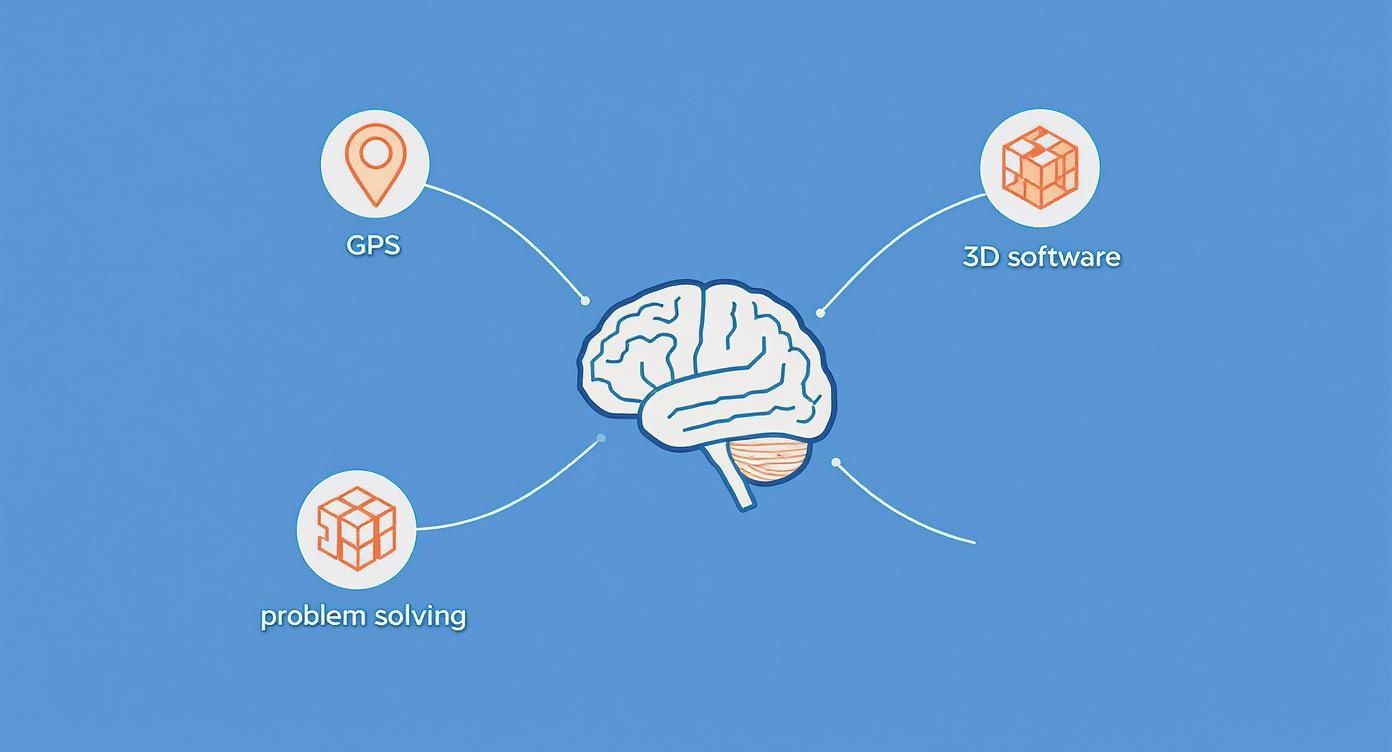
As you can see, these aren't just abstract concepts. They're the engine driving practical abilities like navigation, design, and creative problem-solving.
Spatial Perception: Your Inner GPS
First up, we have spatial perception. This is your brain's built-in awareness of where your body is in relation to the world around you. It’s that gut feeling that lets you weave through a crowded mall without bumping into anyone or grab your water bottle off the desk without even looking.
Spatial perception runs silently in the background, constantly updating your position. Without it, simple tasks like walking through a doorway or sitting down in a chair would feel clumsy and require intense concentration. If you’re ever looking for ways to boost this foundational skill, there are tons of great activities for visual perception that can help sharpen it for both kids and adults.
Ultimately, this skill is all about relational awareness—not just seeing an object, but intuitively understanding where it is in relation to you.
Mental Rotation: The Mind's Eye Flip
Next is mental rotation, one of the coolest parts of spatial intelligence. This is your ability to take an object, pick it up in your mind, and turn it around to see it from all sides. It's the secret weapon you use when playing Tetris, picturing exactly how a block needs to turn to slide perfectly into place.
You use it for everyday things, too, like figuring out which way a key goes into a lock or assembling that dreaded flat-pack furniture. Your brain creates a little 3D model and manipulates it, no hands required.
Mental rotation lets us test out possibilities and solve physical puzzles entirely in our heads. It's like a mental dress rehearsal for real-world action.
This ability is a cornerstone for problem-solving in fields like engineering, architecture, and even surgery, where visualizing parts from different angles is absolutely critical.
Spatial Visualization: The Imagination Engine
Finally, there’s spatial visualization. This goes a step beyond just rotating an object. It's the ability to imagine how something would look if you changed it—if you folded it, cut it into pieces, or reassembled it into something new.
Think about origami. Spatial visualization is what allows you to look at a flat sheet of paper and a diagram, then mentally walk through the folds needed to create a tiny, intricate crane. It's the same skill an architect uses to look at a 2D blueprint and see a fully-formed 3D building in their mind.
Here are a few other times spatial visualization comes in handy:
- Packing a suitcase: You mentally arrange your clothes and toiletries to see how they’ll fit best before you even start.
- Following a map: You visualize the turns and landmarks on your route before you get there.
- Rearranging furniture: You imagine how the couch would look against the other wall without having to do any heavy lifting.
Together, these three components—perception, rotation, and visualization—form the foundation of your visual-spatial skills. They are the mental machinery that allows you to understand, interact with, and creatively shape the physical world around you.
How Spatial Skills Supercharge Learning
Let's be honest, visual-spatial skills sound like something reserved for architects, pilots, or maybe professional Tetris players. But here's the secret: they are a fundamental engine for academic success, acting as a powerful accelerator for learning in just about every subject. They're especially critical in the STEM fields—science, technology, engineering, and mathematics—but their influence quietly props up everything from reading a novel to studying for a history exam.
Think about a student tackling geometry. For someone with strong spatial skills, the abstract ideas of angles, volumes, and transformations aren't just formulas on a page. They can mentally spin a 3D shape, see how its sides connect, and get an intuitive feel for a geometric proof. The subject clicks. It's less about memorizing rules and more about genuine understanding.

This isn’t just a hunch. Study after study confirms a powerful link between spatial reasoning and how well kids do in school. These abilities aren't just helpful—they are often a surprisingly accurate predictor of a child's future academic success.
The Math and Science Connection
In math and science, the ability to visualize isn't a bonus feature; it's a core requirement. Strong visual-spatial skills give students the power to build mental models of complex systems, which is the key to unlocking deep, lasting comprehension. Without this knack, students are often stuck just trying to memorize facts and procedures, never truly grasping the "why" behind them.
Here’s where it really makes a difference:
- Mathematics: It goes way beyond geometry. Spatial skills are essential for making sense of graphs, charts, and even simple number lines. When a student can visualize the space between numbers, they develop a gut feeling for estimation and calculation that you just can't teach from a textbook.
- Chemistry: Trying to understand chemistry without spatial skills is like trying to build a LEGO set with a blindfold on. The ability to picture abstract concepts like molecular bonds is purely a spatial task. Resources for visualizing atomic structures can help make these invisible worlds feel more concrete and understandable.
- Biology: From tracing the pathways of the circulatory system to picturing how DNA strands twist and replicate, biology is packed with intricate spatial arrangements.
- Physics: Concepts like force, velocity, and trajectory are all about objects moving through space. A student with sharp spatial reasoning can better predict how things will move, interact, and behave in the real world.
The evidence backing this up is rock-solid. One major study even found that a child's visual-spatial ability was a huge predictor of their overall academic achievement, especially in math. The researchers showed that these skills directly impact arithmetic ability, which then creates a ripple effect, boosting performance in other subjects, including reading.
Beyond STEM: Reading and Organization
This might sound like a stretch, but visual-spatial skills are also heavy hitters in literacy and organization. The act of reading is more than just recognizing letters; it’s a whole series of spatial tasks we do without even thinking about it.
Just think about what your eyes are doing this very second. They are smoothly tracking lines of text, making precise jumps from the end of one line to the start of the next. Your brain is also processing the spacing between letters and words to tell them apart. These are all subtle, but absolutely essential, spatial skills in action.
Strong visual-spatial skills help organize information not just on a page, but in the mind. A student who can visualize a timeline or create a mental flowchart is using spatial reasoning to structure and retain knowledge.
These abilities are also tied directly to visual memory—the power to recall what you've seen. When a student can easily remember the layout of a diagram from their textbook or the structure of a mind map they drew, studying becomes way more effective. If that sounds like a skill you’d want to sharpen, we have a whole guide on how to improve visual memory.
Ultimately, nurturing these skills from an early age is one of the best things you can do to set a child up for success. It gives them the mental toolkit they need to not only solve problems but to see them from new, creative angles—turning learning from a chore into a genuine exploration.
Turn your kid into the star of the page
Upload one photo and get coloring pages of your own child. Print as many as you like.
Where Visual-Spatial Skills Show Up in Real Life
Think visual-spatial skills are just for architects sketching out skyscrapers or pilots navigating stormy skies? Think again. These abilities are the unsung heroes of countless everyday tasks and a surprising number of careers.
You’re tapping into them when you merge into traffic, pack a suitcase like a Tetris master, or even just follow a new recipe. They’re constantly at work, helping a chef arrange a beautiful plate, a mechanic understand how an engine fits together, or a dancer move across a stage without bumping into anyone.
From the Surgeon’s Scalpel to the Soccer Field
In certain professions, strong visual-spatial skills aren't just a "nice-to-have"—they're the secret sauce. This is what allows specialists to excel in fields demanding incredible precision, foresight, and a deep gut feeling for three-dimensional space. The ability to mentally see, turn, and manipulate objects is a massive advantage.
Just look at these high-stakes examples:
- Surgeons and Dentists: Before a surgeon makes the first cut, they’ve already run through the procedure in their mind’s eye, mapping it out in 3D. A dentist does the same, navigating the tiny, complex landscape of a patient's mouth, often using a mirror to guide their tools with pinpoint accuracy.
- Engineers and Architects: These folks live and breathe spatial reasoning. An architect has to see a whole building just by looking at a 2D blueprint, while a mechanical engineer mentally assembles a machine to spot flaws before a single part gets made.
- Athletes: That perfect three-pointer? That’s a basketball player judging the exact arc needed to sink the shot. A soccer player anticipating the ball's curve to score a goal? That's elite spatial awareness in a split second.
This isn’t just a hunch. Visual-spatial ability has long been tied to success in many fields, especially in STEM and design. Research consistently shows that skills like mental rotation are a strong predictor of high performance in careers that demand 3D thinking. If you want to go deeper, you can learn more about the findings on visual-spatial ability and its professional impact.
The image below gives a great snapshot of just how many jobs rely on these skills.
It’s a surprisingly diverse list, running from the super-technical world of air traffic control to the creative expression of a sculptor.
Unlocking Your Everyday Spatial Genius
You don’t need a specialized career to see your visual-spatial skills in action. They’re woven into the fabric of your daily life, making thousands of little tasks feel smoother and more intuitive. Every time you successfully navigate a crowded grocery store or assemble a piece of IKEA furniture, you’re flexing those spatial muscles.
The Big Idea: Visual-spatial skill isn't some abstract concept—it's the practical ability that helps you parallel park, hang a gallery wall, and figure out the most efficient way to load the dishwasher.
Think about these totally normal scenarios:
- In the Kitchen: Doubling a recipe means you have to visualize different quantities. Icing a cake involves spatial planning to get the design centered and looking sharp.
- Getting Around: Even with GPS, you’re using spatial skills to connect the map on your screen to the real-world streets and turns around you.
- Hobbies and Fun: Planning a garden layout, learning a new dance from a YouTube video, or getting lost in a video game—you are actively using and strengthening your spatial intelligence.
At the end of the day, these skills are fundamental to how we interact with the world around us. Once you start noticing them, you’ll see just how essential they are for getting things done, both effectively and creatively.
Practical Ways to Improve Your Visual Spatial Skills
Here’s the fantastic news: visual-spatial intelligence isn’t something you’re just born with. Think of it like a muscle—the more you work it out, the stronger and sharper it gets. You don't need a fancy gym or expensive gear, either. Your training ground is all around you, packed with fun and engaging activities.
Whether you're a parent hoping to give your child a developmental leg up or an adult looking to sharpen your own mind, building these skills can easily become a fun part of your daily routine. The trick is to turn everyday moments into little spatial exercises.

Hands-On Activities for All Ages
Honestly, the best way to train your spatial brain is to get your hands dirty. When you physically touch and move objects, you forge a powerful connection in your brain between what your eyes see and how things relate to each other in the real world.
For kids, this is the very essence of developmental play. Those activities that just look like simple fun are actually powerful workouts for the brain. For adults, picking up a hands-on hobby does the exact same thing, offering a relaxing escape that also keeps you mentally agile.
Here are a few classic options that really work:
- Building Blocks and LEGOs: These are the undisputed champions of spatial skill training. They teach kids (and adults!) about balance, symmetry, 3D structures, and how tiny pieces come together to create a complex whole. Following the instructions also flexes your ability to turn a 2D diagram into a 3D reality.
- Jigsaw Puzzles: When you’re solving a puzzle, you’re constantly analyzing shapes, colors, and patterns. You have to mentally flip and rotate pieces to see where they might fit—a direct workout for your mental rotation skills.
- Origami and Paper Folding: This ancient art is a fantastic exercise in spatial visualization. You have to look at a flat sheet of paper and imagine the entire sequence of folds needed to create something intricate and three-dimensional.
By getting your hands on things, you're not just playing—you're literally building new neural pathways. You're teaching your brain to see, rotate, and understand the world in three dimensions with greater and greater ease.
Games and Hobbies That Sharpen Your Mind
Beyond the classics, countless games and hobbies are secretly amazing at building up your internal GPS. The key is to find something you genuinely love to do, which makes the "practice" feel completely effortless.
Strategy games, in particular, force you to think several moves ahead, visualizing how the game board—the "space"—will change over time. That kind of forward-thinking is a seriously advanced spatial skill.
Take a look at this breakdown of engaging activities perfect for different developmental stages.
Fun Activities to Boost Visual Spatial Skills
| Age Group | Engaging Activities | Skills Developed |
|---|---|---|
| Young Children | Playing with shape-sorters, matching games, and drawing maps of their room. | Pattern recognition, spatial relationships, and basic navigation. |
| Older Children | Playing map-based video games (like Minecraft), learning chess, or building complex models. | Mental mapping, strategic planning, and 3D visualization. |
| Adults & Teens | Practicing photography (composition/perspective), learning a sport (basketball/soccer), or trying strategy board games. | Spatial awareness, angle judgment, and system thinking. |
Finding an activity you enjoy is the easiest way to stick with it and see real improvement.
Weave Spatial Practice into Your Everyday Life
You don't have to carve out time for a new hobby to get better. You can weave spatial skill-building right into your daily routine just by being a little more mindful of the world around you.
Start by actively using spatial language. Instead of just saying "it's over there," try being more specific: "it's behind the lamp" or "to the left of the bookshelf." This small shift forces your brain to define spatial relationships with more precision.
Another great trick is to challenge your reliance on technology. GPS is a lifesaver, but try navigating a familiar route from memory or by glancing at a physical map beforehand. Mentally tracing the path before you leave your house helps build a much stronger internal map of your surroundings.
Finally, practice visualization. Before you rearrange the furniture, sketch out a quick floor plan. Before you pack a suitcase, take a second to mentally picture how everything will fit inside. These little "mental rehearsals" are quick, simple exercises that pay off big time in strengthening your visual-spatial skills.
Still Have Questions About Visual Spatial Skills?
As you start to see the world through the lens of spatial intelligence, it's natural for a few questions to pop up. It’s a pretty fascinating topic, but some of the ideas can feel a little tangled at first. Let's iron out a few of the most common wrinkles with some straight-up answers.
Are Visual Spatial Skills and Visual Learning the Same Thing?
Nope, but they're definitely close cousins. Think of it like this:
- Visual learning is a preference. It’s how you like to take in information. If you learn best by looking at charts, diagrams, and videos, you're a visual learner. You’re the person who loves looking at the map.
- Visual spatial skill is a cognitive ability. It’s the raw processing power your brain uses to make sense of what you see—interpreting shapes, judging distances, and mentally flipping objects around. It's what lets you actually use that map to get where you're going.
They often go hand-in-hand, but they aren't the same. Someone can prefer visual information without being a master of mental rotation, and vice-versa. One is about input, the other is about processing.
Can Adults Actually Improve Their Visual Spatial Skills?
Absolutely. Your brain’s incredible ability to adapt and rewire itself—a process called neuroplasticity—doesn’t just switch off when you hit adulthood. You can absolutely strengthen these skills at any age.
Jumping into new, hands-on activities is one of the best ways to do it. Regularly playing certain types of video games, taking up a hobby like woodworking or drawing, or even learning a new sport can forge new neural pathways and give your spatial reasoning a serious boost.
You're never too old to build your mental muscle. Every time you solve a new puzzle or navigate to a new place without GPS, you're giving your spatial intelligence a fantastic workout.
At What Age Should Kids Start Developing These Skills?
Development kicks off almost from day one. When a baby reaches for a hanging toy or a toddler gets obsessed with stacking blocks, they're already building the foundational skills for spatial awareness. There’s no magic "starting line" you have to wait for.
The real key is giving kids plenty of age-appropriate opportunities to physically interact with their world. Simple, unstructured play—think puzzles, building toys, and running around outside—is one of the most powerful ways to support their natural development right from the start.
Is There a Link Between Poor Handwriting and Visual Spatial Skills?
Yes, there’s often a very strong connection. Good handwriting is a surprisingly complex task that relies on a whole suite of visual-spatial abilities working together.
A child needs to properly space out letters and words (spatial perception), form the letters correctly (spatial visualization), and keep everything neatly on the line.
When a child really struggles with these things, it can sometimes be related to a condition called dysgraphia, which often has a major visual-spatial component. It’s a perfect reminder of how these abstract cognitive skills have a direct and very practical impact on everyday schoolwork.
Ready to spark some creativity and sharpen those visual skills? At ColorPageAI, you can generate endless custom coloring pages that challenge the mind and delight the senses. From complex patterns to imaginative scenes, bring any idea to life in seconds. Create your first five coloring sheets for free at ColorPage.ai
Turn your kid into the star of the page
Upload one photo and get coloring pages of your own child. Print as many as you like.